Why AI Customer Agents Need Stronger Data Contracts
A customer asks an artificial intelligence service agent to change the delivery address on an order. The agent retrieves the record, confirms the new address, and prepares the update. Its CRM copy does not yet show that the warehouse shipped the package 20 minutes earlier. Every field is valid. The decision is not.
This is not primarily a language-model failure. It is a source-of-truth and transaction-control failure. As customer agents move from answering questions to changing orders, issuing credits, and updating accounts, that distinction becomes operationally important.
Over more than 16 years working with enterprise ETL/ELT, change data capture, distributed processing, and cloud data platforms, I have seen the same lesson recur: a successful pipeline run is not proof that a downstream consumer has the right facts. A green job status tells us processing ran. It does not tell us whether a customer-facing action is still safe.
Conventional data contracts help producers and consumers agree on fields, types, and acceptable values. Those checks matter, but an acting agent must answer different questions. Does this order belong to the authenticated customer? Has fulfillment changed its state? Is the requested use permitted? Can the transaction still be committed?
My proposed extension is a decision-time contract: an explicit set of evidence and policy requirements attached to a consequential customer action. The individual controls are established engineering practices; the contribution here is to bring them together as one testable acceptance gate for CRM agents rather than treating a schema-valid response as sufficient.
Five checks before an agent acts
- Identity and scope. Bind the request to an authenticated customer, account, and specific transaction. A matching household address or merged customer profile is not proof of ownership. Conflicts require clarification.
- Currency and completeness. Define how recent the relevant source state must be and how that is verified. A change data capture checkpoint or source version can be useful when its meaning is established; a timestamp on a replica alone does not prove that all relevant updates arrived. Missing evidence should be marked unknown, not passed.
- Provenance and meaning. Identify the authoritative system and business meaning of each decision-critical fact. "Available" might mean something different in CRM, inventory, and fulfillment.
- Permitted use. Recheck access, consent, and purpose restrictions when the Agent is about to act. Permission valid at ingestion may no longer be valid at execution.
- Action authority and audit. Keep the language model separate from the service authorized to commit a change. That service should enforce eligibility and approval limits and record the policy result, source version, and write outcome.
The threshold should fit the risk. Answering a general product question does not require the same evidence as changing a delivery address or approving a refund. For each action category, the team should specify the authoritative source, acceptable evidence age, required permission, approving service, and fallback when a check cannot be completed. These choices belong in a versioned policy owned jointly by customer operations, security, and engineering, not scattered across prompt templates.
Put the gate in the transaction path
A prompt cannot prove that a replica has received the latest shipment event. Nor can it guarantee that a refund remains eligible. The gate belongs in the access and transaction path, with three explicit outcomes: proceed when evidence and policy pass; clarify or escalate when evidence is insufficient; block when a rule is violated.
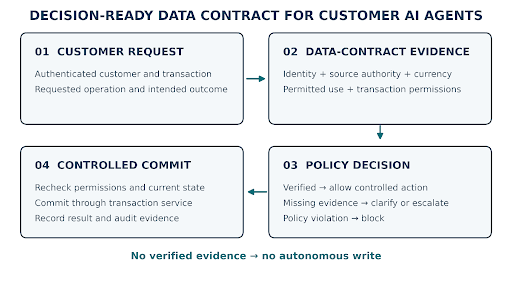
Figure 1. Decision-time checks separate evidence gathering from the authority to change a customer record. Original conceptual illustration; not a product architecture.
Recheck at commit, not just at lookup
For an address change, bind the request to the order ID and an authoritative order-state version. Before writing, the fulfillment service must confirm that the order remains eligible and apply the change only if that version is still current. If the version advanced between lookup and commit, the agent should refresh the record and explain the changed situation, not blindly retry. That is optimistic concurrency control adapted to an agent-mediated customer interaction.
Test the failures a demonstration misses
A pilot can compare two configurations using identical scripted requests and source states: an agent consuming schema-valid API responses, and the same workflow with decision-time checks. Agree on the expected safe outcome before running each test. Then inject four failures: a shipment absent from the CRM replica; conflicting customer identities; consent revoked after synchronization; and refund eligibility changing between lookup and commit.
Measure unsafe transactions completed, legitimate requests incorrectly blocked, escalation time, response latency, and the share of decisions with reconstructable evidence. Segment results by action type and risk level. These are proposed tests and metrics, not claims of completed experiments or measured improvements.
The trade-off is real. More verification can add latency or human handoffs. CRM leaders should measure that customer effort alongside prevented errors rather than assuming every refusal is a failure.
Trust is established at the point of action
A fluent response does not establish that an agent can safely change a customer record. A defensible action depends on the right customer identity, sufficiently current authoritative facts, valid permission, and a transaction service that checks the rules again at commit. Making those requirements explicit is a practical route from persuasive agent demonstrations to dependable customer operations.