Gather the Tools for Customer Engagement
Some forms of social media are tools—blogs, wikis, podcasts. Some are user-generated content (UGC)—comments, reviews, social tags and bookmarks, rankings, ratings, photos, and videos. (There are also more-sophisticated examples, such as social tags used in the creation of folksonomies, organic groups that simplify categorization.)
In early 2008, Forrester Research studied spending levels among 333 interactive marketers at midsize and large corporations.
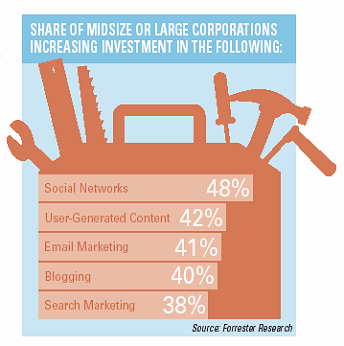
Despite a poor economy, a significant share planned to increase investment in several areas (see chart, above). Yet in terms of display ads, only 10 percent are increasing spending and 40 percent will actually cut back. You could infer that we’re in the early stages of an exodus from traditional marketing—and to some extent you’d be right. But this only means that companies are becoming aware that they have to change how they’re interacting with customers. They aren’t necessarily doing it.
In fact, most of them aren’t. In February, IDC reported that only 14 percent of enterprises polled had social networks; by year’s end, though, that number was expected to reach 41 percent—meaning that white-label social networks (and communities) will be entering the mainstream. Well, maybe: In May, Kathleen Reidy of the analyst firm The 451 Group polled 2,081 technology and business professionals and found only 24 percent had the tools to build or use social media (which the report defined as blogs, wikis, and social networks).
First, don’t be fooled by that number. If 24 percent were using social media, that’s about 24 percentage points more than three years ago. And Forrester’s research indicates a willingness to spend on social media—but not by technology departments.
These social tools can be confusing, and they’re not a clear part of a traditional CRM strategy. The idea is to get acquainted with them first. The social tools most important for CRM (i.e., blogs, wikis, and social networks) deserve more explanation, but suffice to say you need to incorporate them into your engagement strategy.
Remember: These are tools—not substitutes for strategy or for engagement with customers. They have their own benefits and problems and should be used judiciously.
Think that’s an unnecessary reminder? A little history, maestro: The biggest battle CRM vets have had to fight was with our clients. Why? Because the vast majority of those clients saw—and still see—CRM as just a technology. Despite our protestations that CRM was actually a strategy enabled by technology, the myth persisted to the point that practitioners would cripple themselves by implementing CRM before developing a plan for their customers.
The problem is that the industry essentially consists of software and software-as-a-service vendors; they wanted—and still want—to sell technology wares. Vendors might say, “CRM is not about software; it’s all about people,” but it wasn’t people they were trying to sell you the next day.
You think that mind-set has changed? Nope. Businesses tend to throw tools and technology at what are essentially human issues, hoping to automate those issues away. Even today, as we recognize that beneficial customer interactions are governed by trust, transparency, and personalized experiences, the new answer seems to be to throw blogs, wikis, and social networks at the interactions—perhaps tied to some sales, marketing, and customer service applications. Companies will be inclined to use these tools because:
- everyone else is;
- they’re really cool and fun to play with; and
- they seem an easy out for developing a customer engagement strategy. (That thinking will cost you, big time.)
This is, again, the wrong approach.
Take my advice, please. These are social media tools—and they’re meant to be used as enablers, not drivers. More to the point, they’re not substitutes for anything. And, like pretty much everything else in life, the only tools worth using are the ones that have real value.
Paul Greenberg is president of The 56 Group (the56group.typepad.com), a strategic CRM consulting services firm, and a cofounder of CRM training company BPT Partners. The fourth edition of his best-selling book, CRM at the Speed of Light (McGraw-Hill)—from which this article is excerpted—will be out in 2009.
Every month, CRM magazine covers the customer relationship management industry and beyond. To subscribe, please visit http://www.destinationcrm.com/subscribe/.
Related Articles
Managing Social Customers for Profit
01 Aug 2009
A new paradigm calls for a reassessment of an industry metric.
Life in the Fast Lane of Context
01 Jan 2009
Providing an experience requires a better understanding of your customers.
Social Customers Want to Engage
01 Apr 2009
But are you prepared to let them?
Listen and Ye Shall Hear: 2009 Forrester Wave on Listening Platforms
13 Feb 2009
Forrester Wave on Listening Platforms '09: The analyst firm listens closely to a market segment that used to be known as brand monitoring.
CRM 2.0 Is for Real
25 Nov 2008
Forrester Research examines the growing field of social CRM and shows where the value lies.
B2B Marketers Still Hesitant to Get Social
23 Oct 2008
Forrester report shows that B2B marketing, unlike its B2C counterpart, may be lax in diving into Web 2.0 business efforts.
Your Customers Want You to Join Them
06 Oct 2008
New research from Cone LLC finds 93 percent of Americans want companies to have a presence in social media.
Oracle Joins the Conversation
29 Sep 2008
Oracle OpenWorld '08: The vendor introduces and expands Social CRM applications and an initiative to integrate social networking with CRM.
The CRM Social Hour
11 Sep 2008
Gartner CRM Summit '08: Key takeaways include building upon the customer experience and embracing social trends; 90 percent of attendees report CRM budgets have either remained the same or increased over the past year.
The 2008 CRM Market Awards: Influential Leaders -- Paul Greenberg
01 Sep 2008
The Herald: Paul Greenberg -- chief customer officer, BPT Partners; president, The 56 Group.
"White-Label" Social Networking to Hit the Enterprise
23 Jul 2008
ABI Research predicts the industry will reach $1.3 billion within five years.
Attaining Enterprise 2.0 Through 'Social CRM'
29 Jul 2008
Social computing meets business value.
A Company Like Me
01 Jul 2008
It's going to take a very special kind of organization to truly make a personal connection with customers.
Big Red Gets Social
10 Jun 2008
Enterprise megavendor Oracle offers a taste of its social networking-inspired on-demand applications at the Enterprise 2.0 conference.
Studies Show Steadfast Social Networking Growth
12 May 2008
Gartner and IDC reports show Enterprise 2.0 is growing among enterprises and a valuable resource for retailers.
Time for CRM to Get Social
26 May 2008
Why? Because 274 million people use some form of social networking.
Try to Dig What We All Say
01 Nov 2006
It's time for marketers to understand how social networking sites cater to every generation.
Social Networking Continues to Permeate Customer Service Solutions
06 Feb 2008
The expanded partnership between eVergance and Jive Software underscores a growing need to provide tools enabling online consumer forums.
Everything Is Social
01 Mar 2008
The word is everywhere now: social networks, social frameworks, social platforms.
Collaboration: The ''C'' in CRM
30 Jan 2008
CRM is changing, and you better change with it.
Managers Jump Up and Down for Social Networking
31 Mar 2008
Enterprise social networking takes flight with Trampoline Systems' newest release.
Loyalty Versus Commitment
19 Apr 2004
Loyalty doesn't have a bidirectional requirement, but the relationship between customers and a business demands that two-way street.
Tech Solution: Social Networking Tools
01 Nov 2007
Business Problem: Inability to generate qualified contacts and leads within customer companies.
CRM Exclusive: A New Web Site Tailored for CRM Careers
07 Sep 2007
A group of industry pundits will launch a new "online career center" at the Gartner CRM Summit later this month.
Socialized CRM
01 Sep 2008
CRM has never prioritized the individual salesperson—but social networking changes all that.
CRM 2.0 and "The Customer Module"
19 Aug 2008
destinationCRM 2008: The customer module is based on the idea that united we stand, divided we fall -- and it's what CRM has been missing.
CRM’s a Social Animal
01 Jul 2008
On The Scene: Web 2.0 -- As enterprise social computing takes off -- and employees clamor for more -- CRM providers scramble to connect, as well.
Buyer's Guide Companies Mentioned